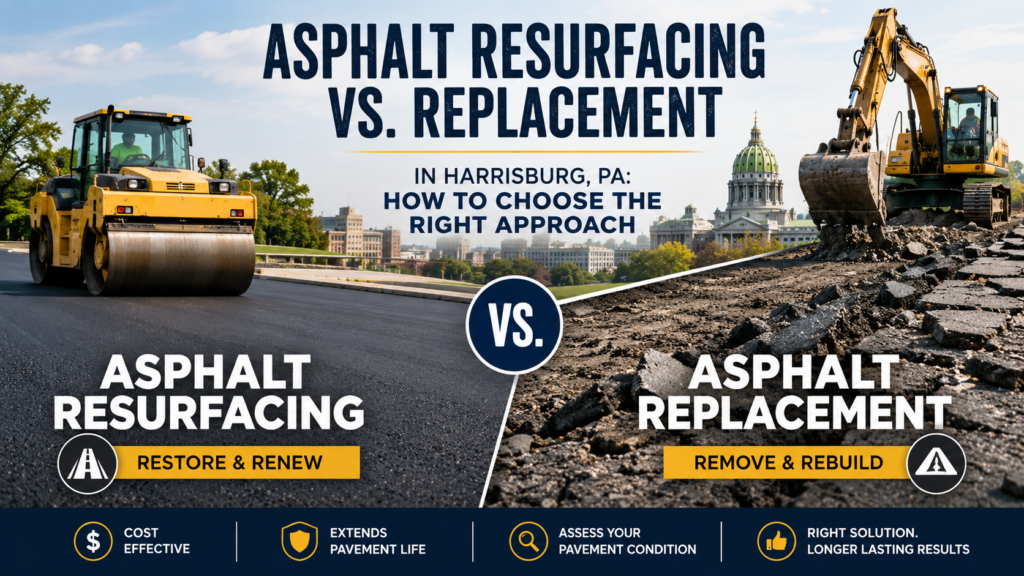
One of the most significant decisions a property owner in Harrisburg faces when their Asphalt Resurfacing vs Replacement Harrisburg reaches a certain stage of deterioration is the choice between resurfacing and full replacement. The two options are not interchangeable each is appropriate under specific conditions, and applying the wrong treatment is one of the most expensive pavement mistakes a property manager can make. Understanding what distinguishes resurfacing from replacement, what conditions warrant each, and how Central Pennsylvania climate factors into the decision equips Harrisburg property owners to make this choice with confidence.
What Is Asphalt Resurfacing?
Asphalt resurfacing also called overlay is the process of applying a new layer of hot mix asphalt over an existing pavement surface. The existing base structure remains in place; only the wearing surface is renewed. When performed correctly on an appropriate candidate, resurfacing adds 8 to 15 years of service life at a fraction of full replacement cost.
A proper resurfacing job in Harrisburg is not simply dropping new asphalt on top of old. It involves thorough preparation: crack filling and pothole repair on the existing surface, milling in areas where curb height or drainage slope would be compromised by adding material directly on top, application of a tack coat to bond the new asphalt layer to the existing surface, and careful attention to drainage transitions. Without this preparation, a resurfacing project will underperform regardless of asphalt quality.
What Is Full Replacement?
Full replacement means removing all existing asphalt material, evaluating and correcting the base and sub-grade as needed, and installing an entirely new pavement structure from the ground up. This is necessary when the base has failed, when freeze-thaw damage has compromised structural integrity beyond the surface layer, or when existing base depth is insufficient for the traffic loads the surface will carry.
Full replacement is a significantly more disruptive and expensive undertaking than resurfacing but it is the only intervention that restores full structural capacity when the base has been compromised. Resurfacing over a failed base is one of the most common and costly pavement management errors in the Harrisburg commercial market. The new surface will crack in the same locations within two to three years because the base failure causing the original problem has not been addressed.
The Base Condition Test
The correct determination between resurfacing and replacement requires an honest assessment of base condition not just surface appearance. Key diagnostic indicators:
- Alligator (fatigue) cracking: Interconnected cracks forming crocodile-scale patterns are the signature of base failure. When alligator cracking covers more than 25 to 30 percent of a pavement area particularly in regularly trafficked zones the base has lost structural integrity. Resurfacing is not appropriate; replacement is required.
- Potholes that recur after patching: Potholes returning quickly after repair indicate the base beneath is saturated and structurally compromised. Patching is temporary; replacement is the structural solution.
- Rutting and depression in traffic lanes: Permanent deformation deeper than one to two inches typically requires full-depth intervention.
- Surface cracking without base failure: Longitudinal cracks, transverse cracks, and block cracking confined to the surface layer without alligator patterns indicates surface aging without structural base failure. This is a resurfacing candidate if cracks are addressed in preparation.
- Faded, oxidized surface with sound base: The ideal resurfacing candidate. The surface has aged; the structure has not.
Harrisburg Climate and Timing
In Central Pennsylvania, the practical resurfacing season runs from mid-April through October, with late spring and early fall being the most favorable windows. Projects scheduled during this window benefit from good working conditions, adequate curing time before the first winter freeze, and the ability to complete follow-up crack sealing and sealcoating before cold weather arrives.
The Economic Case for Proactive Resurfacing
A well-maintained commercial parking lot in Harrisburg that receives resurfacing when the surface has aged but the base remains sound extends its service life by 10 to 15 years at roughly 30 to 50 percent of the cost of full replacement. Deferred action waiting until the base fails converts that option into full replacement at significantly greater cost. The correct timing for resurfacing is after surface-level deterioration becomes apparent but before freeze-thaw cycling advances damage to the structural base.
Conclusion
The choice between asphalt resurfacing and replacement in Harrisburg is fundamentally a question of base condition. When the base is sound and deterioration is confined to the wearing surface, resurfacing is the cost-effective, life-extending intervention. When the base has failed, replacement is the only option that produces lasting results. Making decisions based on honest structural assessment rather than surface appearance alone is the foundation of effective pavement asset management in Central Pennsylvania.